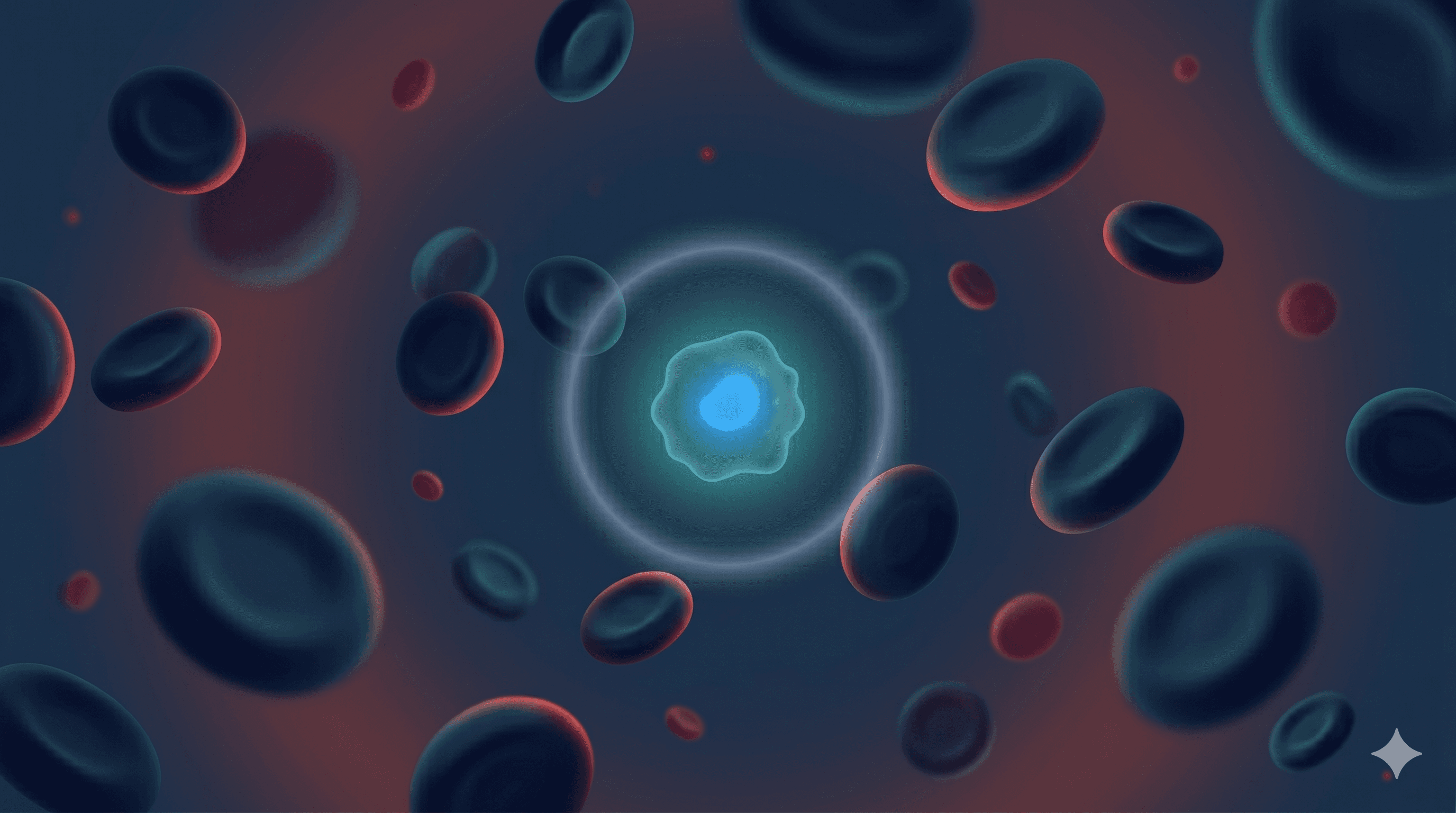
Some blood tests can pick up signs of cancer early by detecting circulating tumor cells (CTCs) — whole cancer cells shed from a tumor into the bloodstream. BloodScan reports detecting CTCs even in pre-invasive conditions such as ductal carcinoma in situ (DCIS) and early hepatocellular carcinoma (HCC), stages where the tumor signal in blood is typically very low. That makes a CTC liquid biopsy a potential window into early disease from a routine blood draw — one that complements, rather than replaces, established cancer screening.
How Can a Blood Test Detect Cancer Early?
A blood-based cancer test looks for material that a tumor releases into circulation. The two main analytes are circulating tumor DNA (ctDNA), fragments of tumor genetic material, and circulating tumor cells (CTCs), which are intact, whole cancer cells. Early-stage tumors shed very little of either, so the central challenge of early detection is sensitivity: finding a faint tumor signal against a large background of normal blood. A method that can reliably capture even rare CTCs has an advantage at the earliest stages, where there may be only a handful of tumor cells in a tube of blood.
What Are CTCs, and Why Do They Matter for Early Detection?
CTCs are cells that have broken away from a primary or metastatic tumor and entered the bloodstream. Because each CTC is a complete, intact cell rather than a fragment, it carries the full biology of the tumor: morphology, proteins, and genome. For early detection, capturing a whole cell means the signal can be confirmed as a recognizable cancer cell rather than inferred from scattered DNA. The difficulty is that CTCs are extremely rare in early disease, which is why the capture technology matters so much.
Detecting Pre-Invasive Disease: DCIS and Early HCC
BloodScan reports that its Labyrinth system uniquely identifies CTCs from the earliest stages, including pre-invasive conditions such as DCIS (ductal carcinoma in situ) and early HCC (hepatocellular carcinoma). These are notable because they sit at the very low-signal end of the disease spectrum. DCIS is a pre-invasive breast condition in which abnormal cells are confined to the milk ducts and have not yet invaded surrounding tissue. Early HCC is liver cancer detected before it has progressed to advanced disease, when tumor burden, and therefore circulating tumor signal, is still small. BloodScan reports detecting CTCs at these stages, which it describes as reaching beyond the limits of traditional liquid biopsy. As with all of BloodScan's platform-reported findings, these results should be understood in a research and platform context rather than as a guaranteed screening outcome for any individual.
Why Intact CTC Capture Matters at Early Stages
Catching cancer early depends on capturing a faint signal without missing it. BloodScan's Labyrinth One is designed for this problem in two ways. First, label-free and antigen-agnostic capture: Labyrinth One isolates CTCs by their physical properties rather than relying on a specific surface marker, so it captures CTCs that marker-dependent methods would miss — a serious advantage when there are only a few cells to find. Second, high capture efficiency: BloodScan reports near-100% capture of CTCs across stage IV solid tumors, with detection extending down to pre-invasive lesions, and high capture efficiency is what makes it possible to recover rare cells from early-stage disease. Learn more on the technology page (/technology-the-labyrinth-one) and product page (/product).
How This Differs From ctDNA-Based Early Detection
Many blood-based early-detection efforts rely on ctDNA. ctDNA can be powerful for genomic screening, but at early stages the amount of tumor DNA in circulation can be vanishingly small, and fragments cannot confirm that the signal came from an intact cancer cell. A CTC approach captures the whole cell, enabling confirmation by morphology and protein expression in addition to genomics. The two are complementary: ctDNA offers broad genomic screening, while intact CTCs add cellular-level confirmation and the ability to study the captured cells directly.
Important Limitations and Context
A blood test that detects CTCs is a promising tool, but a few points are essential for an accurate picture. Detecting CTCs is not the same as a confirmed cancer diagnosis; findings are interpreted alongside imaging, clinical history, and, where feasible, tissue pathology. BloodScan's early-detection results, including in DCIS and early HCC, are platform-reported and belong in a research and clinical-study context, not a guarantee of outcome. And a CTC liquid biopsy is intended to complement established cancer screening programs, not to replace them. Anyone with a personal cancer-risk question should discuss screening options with a qualified clinician. For clinical and laboratory use, see BloodScan's diagnostic services (/services-diagnostic).
FAQ
Can a blood test catch cancer early?
Some can. Blood tests that detect circulating tumor cells (CTCs) look for whole cancer cells shed into the bloodstream. BloodScan reports detecting CTCs even in pre-invasive conditions such as DCIS and early HCC, suggesting a CTC liquid biopsy can provide a window into early disease. It is intended to complement, not replace, established screening, and results are interpreted in a clinical context.
What is the difference between detecting cancer with CTCs versus ctDNA?
ctDNA detects fragments of tumor DNA and supports genomic screening, but at early stages the amount of DNA can be very small and cannot confirm a whole cancer cell. CTCs are intact, whole cells, so capturing them allows confirmation by morphology and protein expression in addition to genomics. The two approaches are complementary.
What are DCIS and early HCC, and why are they significant here?
DCIS (ductal carcinoma in situ) is a pre-invasive breast condition where abnormal cells remain confined to the milk ducts. Early HCC is liver cancer caught before advanced progression. Both have very low circulating tumor signal, so BloodScan's reported detection of CTCs at these stages is notable as a sign of high sensitivity at the earliest end of disease.
Why does label-free CTC capture help with early detection?
Early-stage disease may shed only a few CTCs into the blood, and methods that depend on a single surface marker can miss cells that do not express it. BloodScan's Labyrinth One is label-free and antigen-agnostic, isolating cells by physical properties so it can capture rare CTCs regardless of surface phenotype, which is important when every cell counts.
Is a CTC blood test a replacement for cancer screening?
No. A CTC liquid biopsy is designed to complement established screening programs, not replace them. Detecting CTCs is not a confirmed diagnosis on its own; findings are interpreted alongside imaging, clinical history, and tissue pathology where feasible. Anyone with a personal cancer-risk question should talk with a qualified clinician.