CTC Enumeration vs ctDNA for Monitoring Treatment Response in Clinical Trials
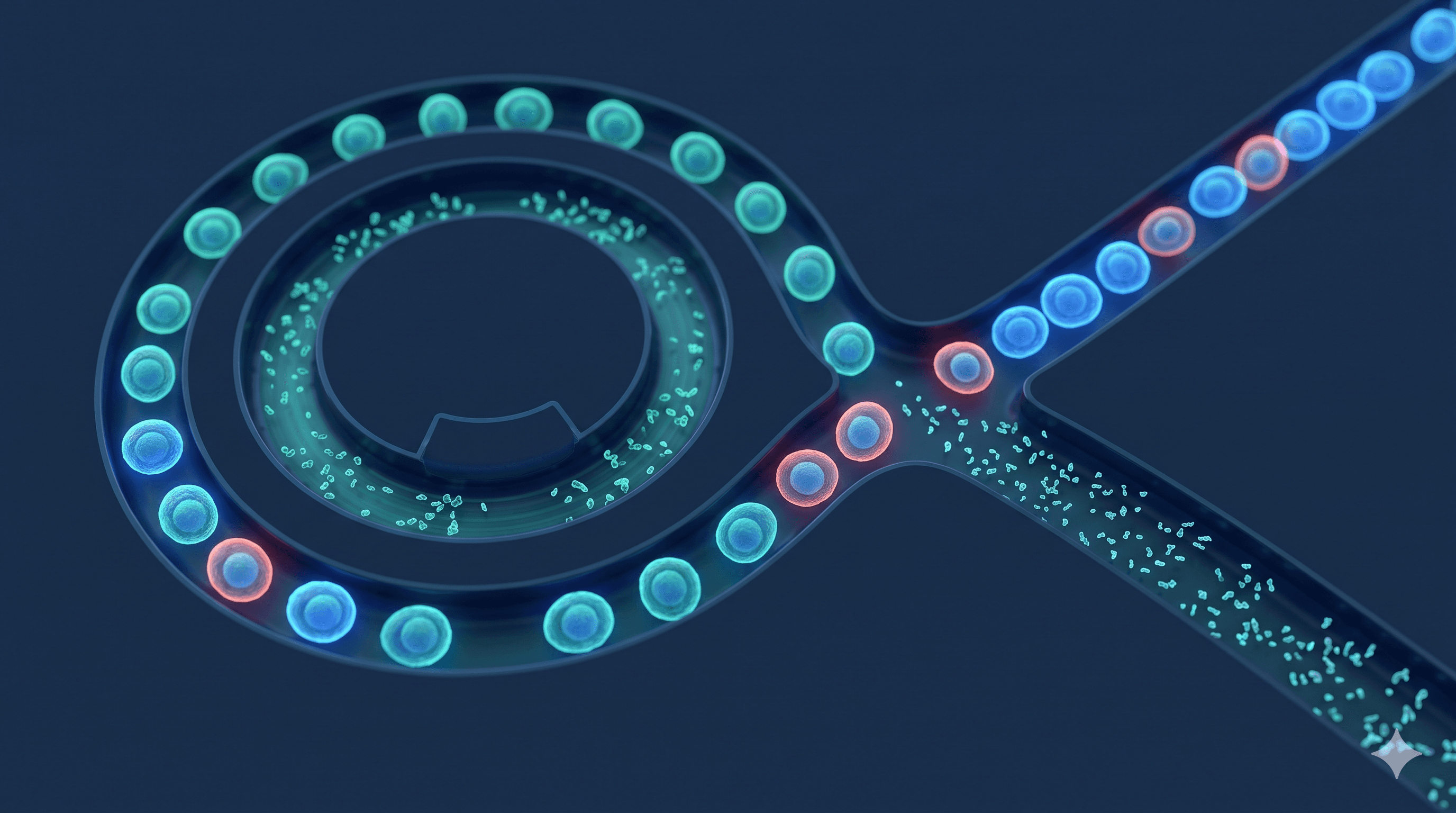
In oncology clinical trials, CTC enumeration and ctDNA analysis are two complementary liquid biopsy approaches for monitoring how a patient's disease responds to treatment. CTC enumeration counts intact circulating tumor cells captured from a blood sample, while ctDNA analysis quantifies fragments of tumor-derived DNA in plasma. The right choice depends on what a trial needs to measure: whole, viable cells for functional and protein-level study, or molecular changes detected at very low abundance.
Both signals come from a routine blood draw, both can be repeated over time, and both are increasingly written into translational and clinical trial protocols. They answer different questions, and many modern trial designs use them together.
What is CTC enumeration?
CTC enumeration is the counting of circulating tumor cells — whole cancer cells that have shed from a primary or metastatic tumor into the bloodstream. A rise or fall in CTC count over the course of treatment can serve as a pharmacodynamic readout: a marker of whether the tumor burden circulating in the blood is changing.
Because CTCs are intact cells, enumeration is only the starting point. The same captured cells can be characterized by their proteins, morphology, and — when isolated alive — their behavior in downstream functional assays. This is the central advantage of working with cells rather than fragments.
What is ctDNA analysis?
Circulating tumor DNA (ctDNA) is the fraction of cell-free DNA in plasma that originates from tumor cells. ctDNA assays measure quantities such as variant allele frequency or the presence of specific mutations, and changes in these molecular signals are used to infer treatment response and, in some settings, molecular residual disease.
ctDNA is a fragmented, molecular signal. It is well suited to detecting genomic alterations and tracking them at low abundance, but the analyte is degraded DNA — not a living cell — so it cannot support cell-level protein analysis or functional drug-response testing.
CTC enumeration vs ctDNA: key differences for trial monitoring
What each signal represents
CTC enumeration reports a cell count: how many intact tumor cells are present in a defined blood volume. ctDNA reports a molecular fraction: how much tumor DNA, and which alterations, are present in plasma. One is a cellular census; the other is a genomic measurement. A trial team should decide which is the more relevant endpoint for the biology and the drug being studied.
Functional and downstream analysis
This is where the two diverge most sharply. ctDNA, being fragmented DNA, supports genomic and methylation analyses but nothing at the level of an intact cell. CTCs that are captured intact and viable can be used for protein expression, single-cell characterization, ex vivo culture, and functional drug-response assays. For trials that aim to understand mechanism of action or resistance at the cell level, viable CTCs open doors that ctDNA cannot.
Serial monitoring over time
Both analytes are obtained from blood, so both lend themselves to serial sampling across treatment cycles — a major advantage over repeat tissue biopsy. Trial teams can build longitudinal response curves from sequential draws, choosing CTC counts, ctDNA levels, or both as the tracked variable, without subjecting patients to repeated invasive procedures.
When to use CTC enumeration to monitor treatment response
CTC enumeration is a strong fit when a trial wants a cell-based pharmacodynamic marker, when the downstream plan calls for protein- or phenotype-level characterization, or when functional assays on living tumor cells are part of the scientific question. Because BloodScan's Labyrinth One technology recovers intact, viable CTCs, enumeration and deep cell-level characterization can be performed on the same isolated cells — a single workflow that goes from count to function. Learn more about the diagnostic and research services BloodScan offers.
When ctDNA is the better fit
ctDNA is well suited to detecting and tracking specific genomic alterations, monitoring known mutations over time, and assaying very low-abundance molecular signals. Where a trial endpoint is fundamentally genomic — a defined mutation or molecular residual disease signal — ctDNA may be the more direct readout. Many trials do not treat this as either/or, and instead pair a molecular signal with a cellular one.
Why intact, viable CTCs matter for trial monitoring
The value a CTC platform delivers depends heavily on the quality of the cells it recovers. Many enrichment methods rely on antibodies against surface markers such as EpCAM, which can miss cells that have downregulated those markers — for example during epithelial-to-mesenchymal transition.
BloodScan's Labyrinth One is label-free and antigen-agnostic: it separates CTCs by their physical properties rather than relying on specific surface markers, and it recovers cells intact and viable. BloodScan reports that this enables both reliable enumeration and the full range of downstream cell-level analysis on the same sample. For trial teams, antigen-agnostic capture reduces the risk of systematically missing biologically important subpopulations. Read how the Labyrinth One platform works, or see the full product overview.
Using CTC and ctDNA together in trial design
CTC enumeration and ctDNA are not competitors so much as complementary layers of evidence. ctDNA can surface genomic alterations and track them molecularly; CTC enumeration adds a cell count, and intact-CTC workflows add protein, phenotype, and functional readouts on top. A trial that captures both gains a more complete picture of how the tumor is responding — at both the molecular and the cellular level — from the same series of blood draws.
The practical decision for a trial team comes down to the endpoint. If the question is "how is the tumor changing at the molecular level," ctDNA is a natural fit. If the question is "how many viable tumor cells remain, and how are they behaving," intact-CTC enumeration is the stronger tool — and it keeps the door open to functional follow-up.
FAQ
What is the difference between CTC enumeration and ctDNA?
CTC enumeration counts intact circulating tumor cells in a blood sample, while ctDNA analysis measures fragments of tumor-derived DNA in plasma. CTCs are whole cells that can be studied for protein expression and function; ctDNA is a fragmented molecular signal best suited to detecting genomic alterations.
Can CTC counts be used to monitor treatment response in clinical trials?
Yes. Changes in CTC counts across treatment cycles can serve as a cell-based pharmacodynamic marker of how circulating tumor burden is responding. Because the measurement comes from a blood draw, it can be repeated serially without repeat tissue biopsy.
Why do intact, viable CTCs matter compared with ctDNA?
Intact, viable CTCs can be characterized at the protein and single-cell level and used in functional drug-response assays — analysis that fragmented ctDNA cannot support. BloodScan's Labyrinth One recovers CTCs label-free and antigen-agnostically, so the same cells used for counting can also be studied functionally.
Should an oncology trial use CTCs or ctDNA?
It is often not an either/or decision. ctDNA is well suited to tracking specific genomic alterations, while CTC enumeration adds a cellular count and the option for downstream functional work. Many modern trial designs pair both to capture molecular and cellular response from the same blood draws.
Does antigen-agnostic CTC capture improve trial data?
Antibody-based capture can miss tumor cells that have downregulated markers such as EpCAM. A label-free, antigen-agnostic method like Labyrinth One separates cells by physical properties instead, which BloodScan reports reduces the risk of systematically missing biologically important CTC subpopulations.