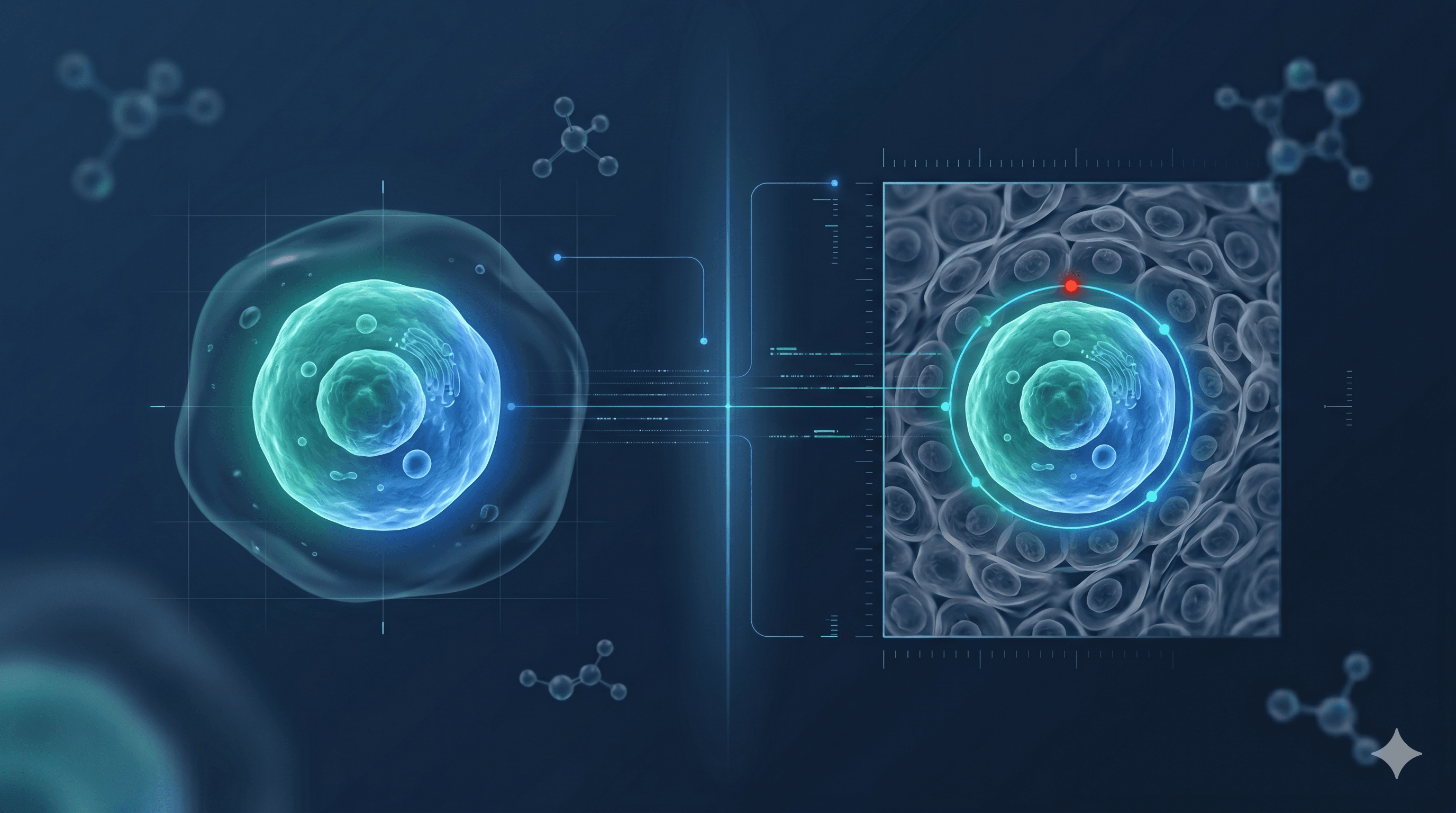
A CTC liquid biopsy's accuracy comes down to two questions: how reliably it captures circulating tumor cells from blood, and how faithfully those captured cells reflect the underlying tumor. BloodScan reports 97% genomic concordance between its intact circulating tumor cells (CTCs) and matched tissue, alongside near-100% capture of CTCs across stage IV solid tumors. Because the platform isolates whole, intact cells rather than fragmented DNA, accuracy can be evaluated at the level of an entire cell — its morphology, protein expression, and genome together.
What Does "Accurate" Mean for a Liquid Biopsy?
Accuracy in a liquid biopsy is not a single number. Sensitivity is how often the test detects tumor signal when cancer is present. Specificity is how often it correctly returns negative when cancer is absent. Concordance with tissue is how closely the molecular findings from blood match a matched tissue sample, the diagnostic reference standard. For a CTC platform, capture efficiency is foundational: if cells are not reliably isolated from the blood, nothing downstream can be accurate. That is why capture rate and tissue concordance are the two figures that matter most.
How Accurate Is a CTC Liquid Biopsy?
For BloodScan's Labyrinth One platform, two reported figures anchor the accuracy story. First, 97% genomic concordance with matched tissue: BloodScan reports that the genomic profile of its intact CTCs agrees with matched tissue in 97% of cases. Second, near-100% capture across stage IV solid tumors: BloodScan reports near-100% capture of CTCs in stage IV breast, lung, pancreatic, and virtually all solid cancers. These are platform-reported figures and should be interpreted in the appropriate clinical or study context rather than as a guaranteed diagnostic result for any individual patient.
Why Intact, Whole Cells Improve Accuracy
Most liquid biopsy accuracy conversations center on circulating tumor DNA (ctDNA), which analyzes fragments of tumor DNA. ctDNA supports genomic analysis but cannot confirm the signal came from a whole, living tumor cell. A CTC liquid biopsy captures the entire cell, which improves accuracy in three ways. Cell-level confirmation: an intact CTC can be examined for morphology and protein expression, so the signal is confirmed at the level of a recognizable cancer cell. No marker bias: BloodScan's Labyrinth One is label-free and antigen-agnostic, isolating cells by physical properties rather than a surface marker such as EpCAM, so it captures CTCs that marker-dependent methods would miss. A complete, re-testable sample: because cells are isolated intact and viable, the same sample supports histology, genomics, and functional assays, so findings can be cross-checked across modalities. Learn more on the technology page (/technology-the-labyrinth-one) and product page (/product).
What 97% Concordance With Tissue Actually Means
Tissue biopsy is the diagnostic gold standard, so the most meaningful accuracy test for a blood-based method is how well it matches tissue. A reported 97% genomic concordance means that, in the large majority of cases, the actionable genomic information you would obtain from tissue is also present in the intact CTCs captured from a blood draw. That closeness is what makes a CTC liquid biopsy usable when tissue is unavailable, unsafe, or insufficient.
Factors That Affect CTC Liquid Biopsy Accuracy
Real-world accuracy is shaped by disease stage, since CTCs are more abundant in advanced disease and signal is strongest at stage IV; by capture method, since label-free, antigen-agnostic enrichment captures a broader range of CTC phenotypes than marker-dependent methods; by pre-analytics, since blood tube type, time to processing, and handling affect how many viable cells survive to analysis; and by the downstream assay, since genomic concordance, protein assays, and functional readouts each have their own performance characteristics.
How BloodScan Approaches Accuracy
BloodScan positions Labyrinth One as a non-invasive, biopsy-equivalent alternative built around capturing intact, viable CTCs. The reported near-100% capture in advanced disease addresses the sensitivity side of accuracy, while the reported 97% genomic concordance with matched tissue addresses how well the blood result reflects the tumor. For clinical and laboratory use, see BloodScan's diagnostic services (/services-diagnostic).
FAQ
Is a CTC liquid biopsy accurate?
A CTC liquid biopsy's accuracy depends on how reliably it captures circulating tumor cells and how closely those cells match the tumor. BloodScan reports near-100% capture across stage IV solid tumors and 97% genomic concordance with matched tissue. These are platform-reported figures, interpreted in the appropriate clinical or study context.
What is genomic concordance, and why does 97% matter?
Genomic concordance measures how closely molecular findings from blood agree with a matched tissue sample, the diagnostic reference standard. BloodScan reports 97% concordance between its intact CTCs and matched tissue, meaning the actionable genomic information from blood closely tracks tissue in the large majority of cases.
Are CTCs more accurate than ctDNA?
They are different rather than strictly better. ctDNA analyzes fragmented tumor DNA and supports genomics only. Intact CTCs preserve a whole, viable cell, allowing morphology, protein expression, and functional assays in addition to genomics, so the signal can be confirmed at the cellular level.
Does the capture method affect accuracy?
Yes. Methods that rely on a single surface marker can miss CTCs that do not express it, creating false negatives. BloodScan's Labyrinth One is label-free and antigen-agnostic, capturing CTCs regardless of surface phenotype.
Can a CTC liquid biopsy replace a tissue biopsy?
Not as a general rule. Tissue biopsy remains the diagnostic gold standard where the lesion is accessible. A CTC liquid biopsy is most valuable when tissue is unavailable, unsafe, or insufficient, and for repeat monitoring over time.