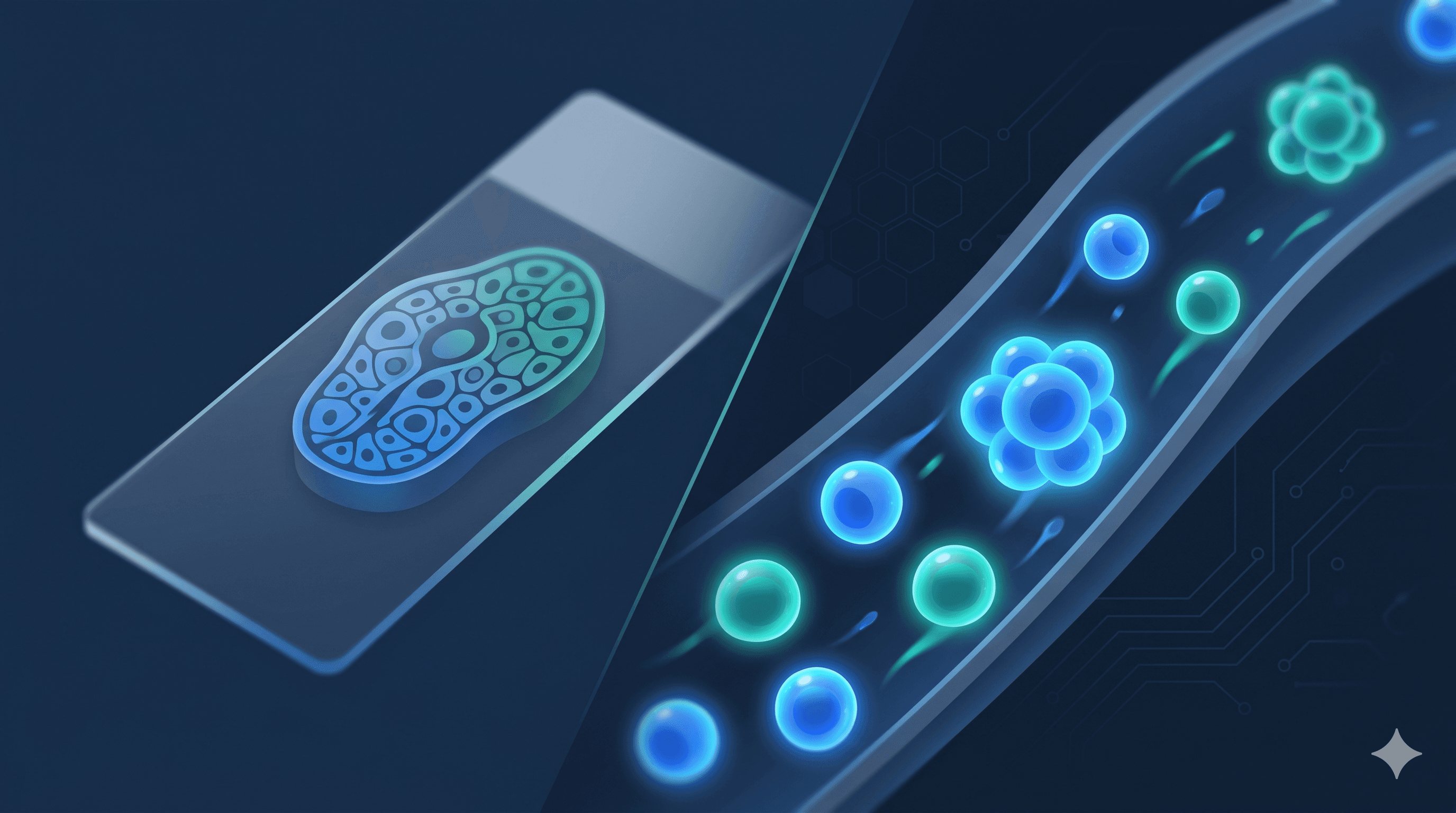
Tissue biopsy is the long-standing diagnostic gold standard, but it samples a single tumor site at a single point in time and is not always feasible. Liquid biopsy analyzes tumor material from a simple blood draw, enabling repeat, near real-time sampling when tissue is unsafe, inaccessible, or insufficient. The two approaches are complementary rather than competing: tissue confirms and characterizes the lesion you can reach, while liquid biopsy monitors disease over time and reaches patients tissue cannot.
What Is a Tissue Biopsy?
A tissue biopsy removes a physical sample of a suspected tumor through a surgical, core-needle, or fine-needle procedure so a pathologist can examine cell morphology, tissue architecture, and protein expression directly under a microscope. It remains the reference standard for an initial cancer diagnosis because it allows definitive histological confirmation and grading. Its limitations are practical: a biopsy captures only the portion of tumor the needle reaches, so it can miss heterogeneity within a lesion or between metastatic sites; it is invasive, carries procedural risk, and may be impossible when a tumor is hard to reach, when a patient cannot tolerate the procedure, or when there is not enough tissue to test.
What Is a Liquid Biopsy?
A liquid biopsy detects and analyzes tumor-derived material circulating in the bloodstream from a routine blood draw. The two most common analytes are circulating tumor DNA (ctDNA), fragments of genetic material shed by dying tumor cells, and circulating tumor cells (CTCs), intact whole cancer cells shed from a tumor into the blood. Because it relies on a blood sample rather than a surgical procedure, a liquid biopsy is minimally invasive, repeatable, and can be performed serially to follow disease over time. Learn more on the technology page at /technology-the-labyrinth-one
Tissue Biopsy vs Liquid Biopsy: Key Differences
Invasiveness and repeatability: tissue biopsy is a procedure with risk and recovery and is hard to repeat, while a liquid biopsy uses a standard blood draw into EDTA or compatible tubes and can be repeated at each treatment timepoint. What you can measure: tissue biopsy provides histology, morphology, and spatial context; ctDNA provides genomic information but no intact cells; intact CTCs preserve a whole cell, enabling morphology, protein expression, genomics, and functional study from blood. Tumor heterogeneity and timing: a tissue sample is one location at one moment, while blood sampling can reflect multiple sites and be repeated to capture how disease evolves. Feasibility: when a lesion cannot be safely biopsied, liquid biopsy may be the only route to molecular information, and BloodScan positions Labyrinth One as a non-invasive, biopsy-equivalent alternative for these patients.
When Tissue Biopsy Makes Sense
Tissue biopsy is typically the right first step when a definitive initial diagnosis and histological grading are needed and the lesion is safely accessible. It is the standard for establishing tumor type, assessing tissue architecture, and performing the established pathology workups that treatment decisions are built on.
When Liquid Biopsy Makes Sense
Liquid biopsy makes sense when tissue is unavailable, unsafe, or insufficient, and when the clinical question is about change over time rather than a one-time diagnosis. Common scenarios include serial monitoring during treatment, where repeat tissue biopsies are impractical but blood draws are easy to schedule; inaccessible or high-risk lesions, where a needle procedure is dangerous or impossible; insufficient tissue, where a prior biopsy did not yield enough material; and a need for systemic sampling, where a single-site biopsy may not represent metastatic disease. See our clinician-facing diagnostic services at /services-diagnostic
Where Intact CTCs Bridge the Two Approaches
Most liquid biopsy conversations focus on ctDNA, which delivers genomic fragments but no cells. Intact CTCs occupy a middle ground: captured from a blood draw like other liquid biopsy analytes, yet preserving the whole, viable cell the way a tissue sample preserves cells, making them suited to morphology and functional work that ctDNA cannot support. BloodScan Labyrinth One is a label-free, antigen-agnostic system that isolates CTCs by their physical properties rather than a specific surface marker. BloodScan reports near-100% capture of CTCs across stage IV solid tumors, detection of CTCs even in pre-invasive conditions such as DCIS and early HCC, and 97% genomic concordance between its intact CTCs and matched tissue, with cells isolated intact and viable and ready for histology, genomics, and advanced functional assays. Read more on the Labyrinth One product page at /product
Using Both Together
For many programs the most informative strategy is to sequence the two methods: tissue biopsy establishes the initial diagnosis and baseline characterization where feasible, and liquid biopsy, including intact-CTC analysis, monitors response, recurrence, and tumor evolution over time without repeated invasive procedures. When tissue is unavailable from the start, a whole-cell liquid biopsy offers a route to comparable molecular and cellular insight.
FAQ
Is liquid biopsy a replacement for tissue biopsy?
Not in general. Tissue biopsy remains the diagnostic gold standard for an initial diagnosis where the lesion is accessible, while liquid biopsy is complementary, valuable for repeat monitoring and for patients where tissue is unsafe, inaccessible, or insufficient.
What is the main difference between CTCs and ctDNA?
ctDNA consists of tumor DNA fragments and supports genomic analysis only, while CTCs are intact whole tumor cells that additionally preserve cell morphology and viability for protein-level study and functional assays.
When is a tissue biopsy not possible?
When a tumor is in a high-risk or hard-to-reach location, when a patient cannot safely tolerate the procedure, or when a prior biopsy did not yield enough usable tissue.
Can a blood test provide tissue-equivalent information?
For intact CTCs, BloodScan reports 97% genomic concordance with matched tissue, suggesting blood-derived intact cells can carry molecular information closely aligned with the tumor; treat this as a research and platform-reported finding in the appropriate clinical or study context.
How does BloodScan fit between tissue and ctDNA?
BloodScan Labyrinth One isolates intact, viable CTCs label-free and antigen-agnostically from a routine blood draw, positioning it between a one-time tissue sample and DNA-only ctDNA, offering whole-cell biology like tissue while remaining minimally invasive and repeatable like other liquid biopsies.